September 18 was a Friday, five days since HAYAT’s bank account was frozen. I was speaking to Isa (pseudonym), a 48-year-old Indonesian mother who’s spent more than 17 years in prison for drug trafficking. She calls me every Friday afternoon from Penjara Kajang, and there is always an earnest yearning for human connection in her soft voice.
She had finally been allowed to pick up skills such as baking. (Malaysia does not offer death row prisoners access to vocational activities.) The KLCC cake she’s made — meaning a combination of (k)ek (l)apis, (c)hocolate, and (c)heese — is amazing.

The day we collected Isa’s cake from prison and devoured it. April 2026.Isa was my age (31) when she was arrested, and subsequently sentenced to death, for carrying heroin into Malaysia in 2009. It took 15 years of solitary confinement before her death sentence was reduced to 30 years’ imprisonment following Malaysia’s abolition of the mandatory death penalty.
The cherry on top of Isa’s 17-year stint in chains is that that’s not even her actual name. The name on the passport she used to enter Malaysia is different from what’s on her birth certificate. But this was never uncovered throughout her trial in Malaysia, let alone investigated. Who was capable of falsifying her name on the passport? Who gave her the passport? Who put her on a flight to Malaysia?
Better yet, what kind of an organised crime group can pull off all of the above? Who’s holding them accountable?
Isa never got her answers, but she continues to sound cheerful and hopeful every week. “Thank you so much, Miss. I’ll call you the same time next week!”
I hung up on the call as I arrived at HAYAT’s new shared office with Mandiri, an organisation that’s been doing so well in youth empowerment for democratic reform in Malaysia that they’ve garnered fans (Malaysian authorities).
As I settled down to have my lunch in the shared pantry, I found two policemen, who identified themselves as PDRM’s AMLA (Anti-Money Laundering) unit officers, standing by our front door.
The two-man team grew into a battalion of almost 20 men over the next few (long) hours in our office. We asked them for the basis of the raid investigation at every possible juncture. No answer. We asked for the purpose of the investigation. No answer. We asked for the lead investigator to present himself to our office. No show.
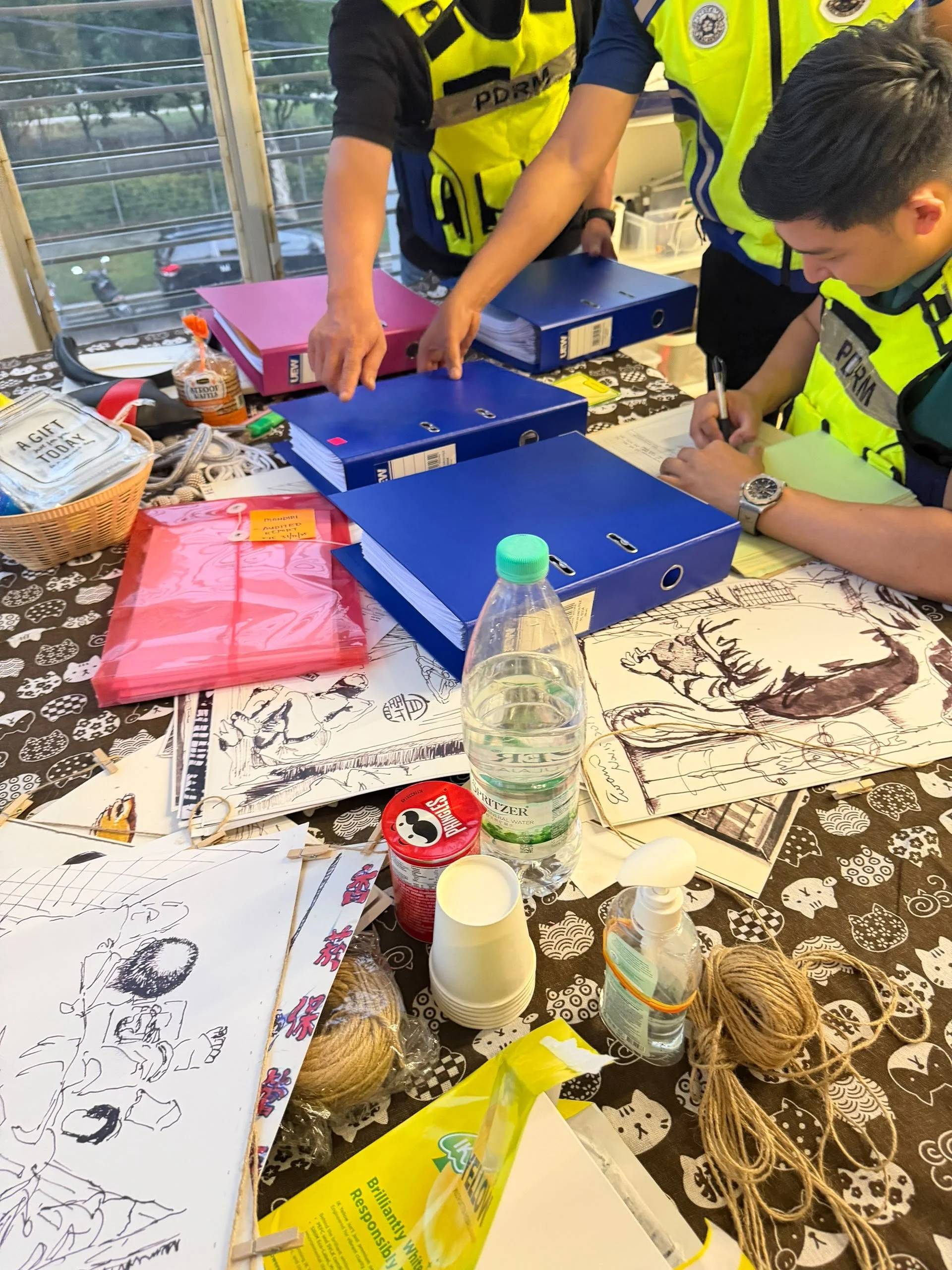
My view of the officers examining what they were taking away from our office. September 2026.HAYAT’s Dobby and MANDIRI’s Amir were subsequently arrested by the AMLA unit four days later for “suspicion of engaging” in laundering “proceeds from an unlawful activity” under the Anti-Money Laundering, Anti-Terrorism Financing and Proceeds of Unlawful Activities Act (AMLA).
This was three months after the same law was invoked to bust a transnational scam syndicate and seize nearly RM58 million in assets. Transnational. Syndicate.
One might ask, what is the “unlawful activity” the men and both organisations were allegedly engaged in? What type of organised crime were they involved in? Online scams? Drugs? You’d be waiting for an answer that still eludes us almost two months after that raid on our office.
In the absence of tangible accusations from the authorities, this continued asset freeze and harassment against HAYAT means that my weekly calls with Isa went from “How can I help?” to “I’m so sorry there’s nothing I can do right now, but what I can afford is to lend you an ear.” It means that our determination to find answers for Isa, and many more women like her who spent over a decade in solitary confinement cells, has been robbed by a government that has, so far, no intention of informing us what kind of criminals we allegedly are.
The irony of the government’s harassment against us and our drug policy work while gripping onto a 50-year-long obsession with the war on drugs is not lost on us — especially when the Director of Malaysia’s Federal Narcotics Crime Investigation Department has proclaimed that states “have to work together as these (drug) syndicates know no borders.”
We agree on that point, Director. My conversations with dozens of women condemned to death for drug trafficking have taught me that transnational syndicates function as sophisticated multinational enterprises optimising supply chains and maximising their profit margins by treating the lowest rungs of their supply chains as outsourced labour. Meanwhile, couriers such as Isa bear all of the risk while receiving none of the value generated across the supply chain.
How do you hold a multinational company committing labour violations accountable? You start by listening to its members of staff. The recent 35th Session of the UN Commission on Crime Prevention and Criminal Justice saw the adoption of Resolution 35/2, which explicitly recognises trafficking in persons for the purpose of forced criminality. It establishes that individuals should not be arrested, prosecuted, or punished for crimes committed as a direct consequence of their trafficking status. The UNTOC Working Group on Trafficking in Persons subsequently urged states to institutionalise the Non-Punishment Principle (NPP) and shift focus from routine drug seizures toward parallel financial investigations and asset tracing.
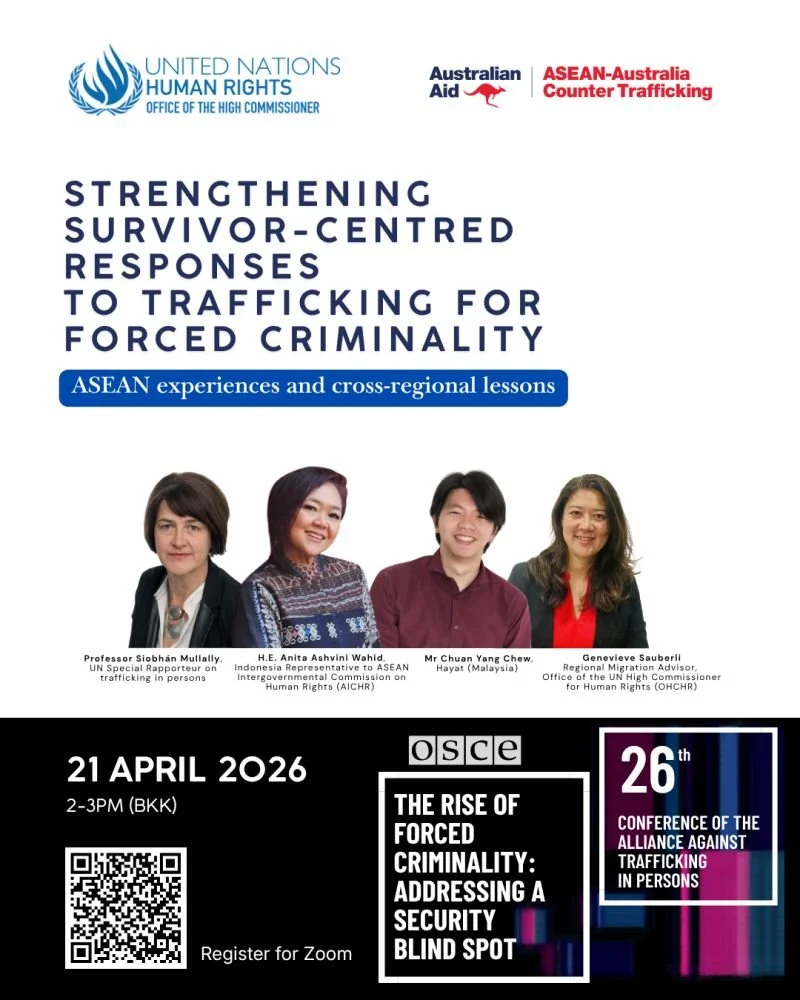
Dobby’s participation at the OSCE’s side event during the 26th Conference of the Alliance Against Trafficking in Persons. April 2026.HAYAT has been heeding that call. We co-convened a regional strategy meeting on the issue earlier this year alongside the Global Alliance Against Traffic in Women (GAATW) and ASEAN-Australia Counter Trafficking (ASEAN-ACT). Dobby Chew had also been extensively involved in drafting the newly validated ASEAN Indicators on Trafficking for Forced Criminality, which aim to improve regional frontline responses for people like Isa.
So why HAYAT’s bank account remains frozen, HAYAT has been heeding that call. We co-convened a regional strategy meeting on the issue earlier this year alongside the Global Alliance Against Traffic in Women (GAATW) and ASEAN-Australia Counter Trafficking (ASEAN-ACT). Dobby Chew had also been extensively involved in drafting the newly validated ASEAN Indicators on Trafficking for Forced Criminality, which aim to improve regional frontline responses for people like Isa.given our scope of work, is still a mystery to me. Is this an uninformed undermining of our attempt to understand the very syndicates that “know no borders”? Is this a bizarre misstep to put civil society organisations in the same category as transnational syndicates?
Wainwright made an acute observation of states’ responses to drug trafficking in his book ‘Narconomics’. “It’s not that the eradication strategy is having no effect. Rather, the problem is that its impact is felt by the wrong people.”
And at the point of me writing this, it feels as if HAYAT’s part of the ‘wrong’ people too.